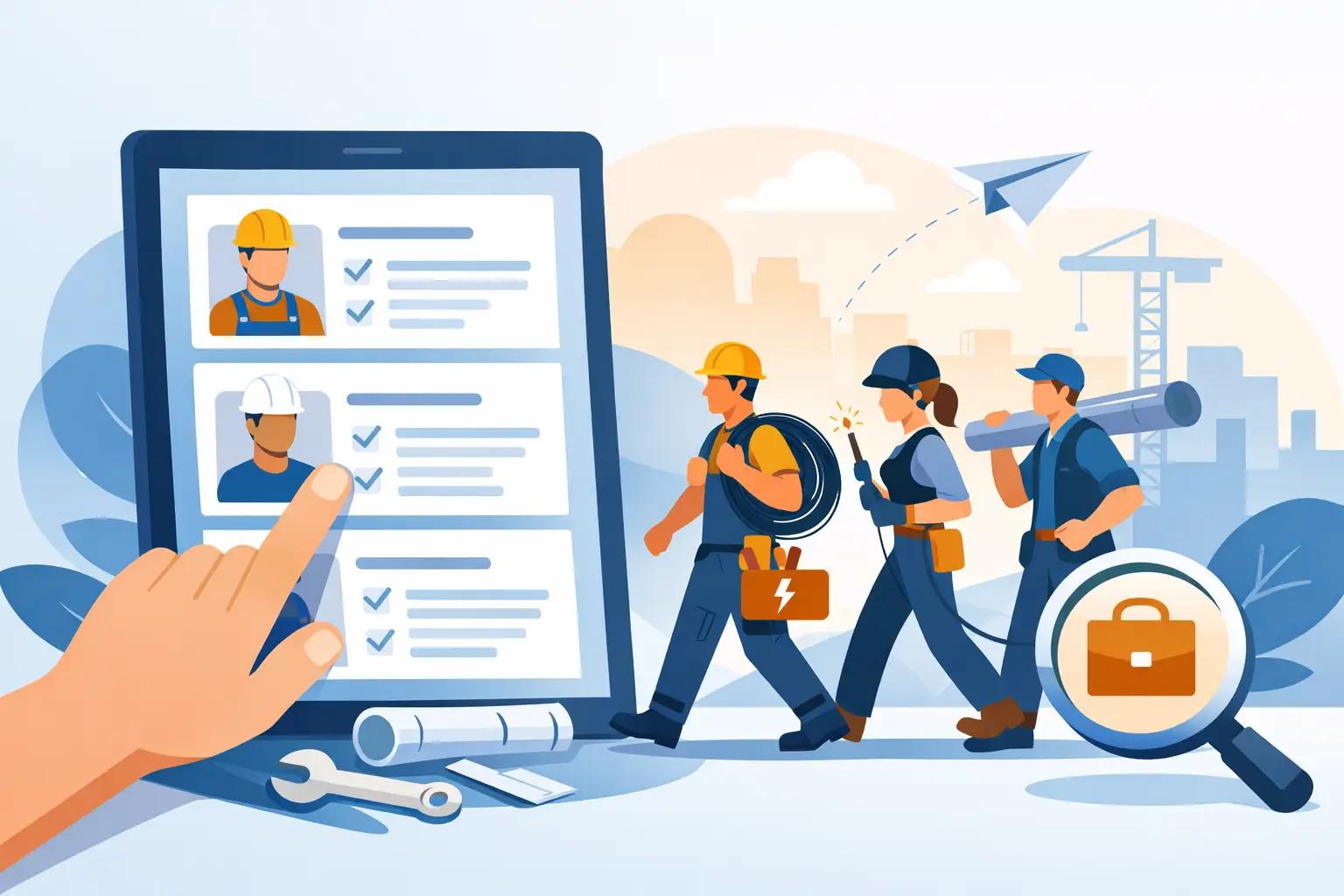
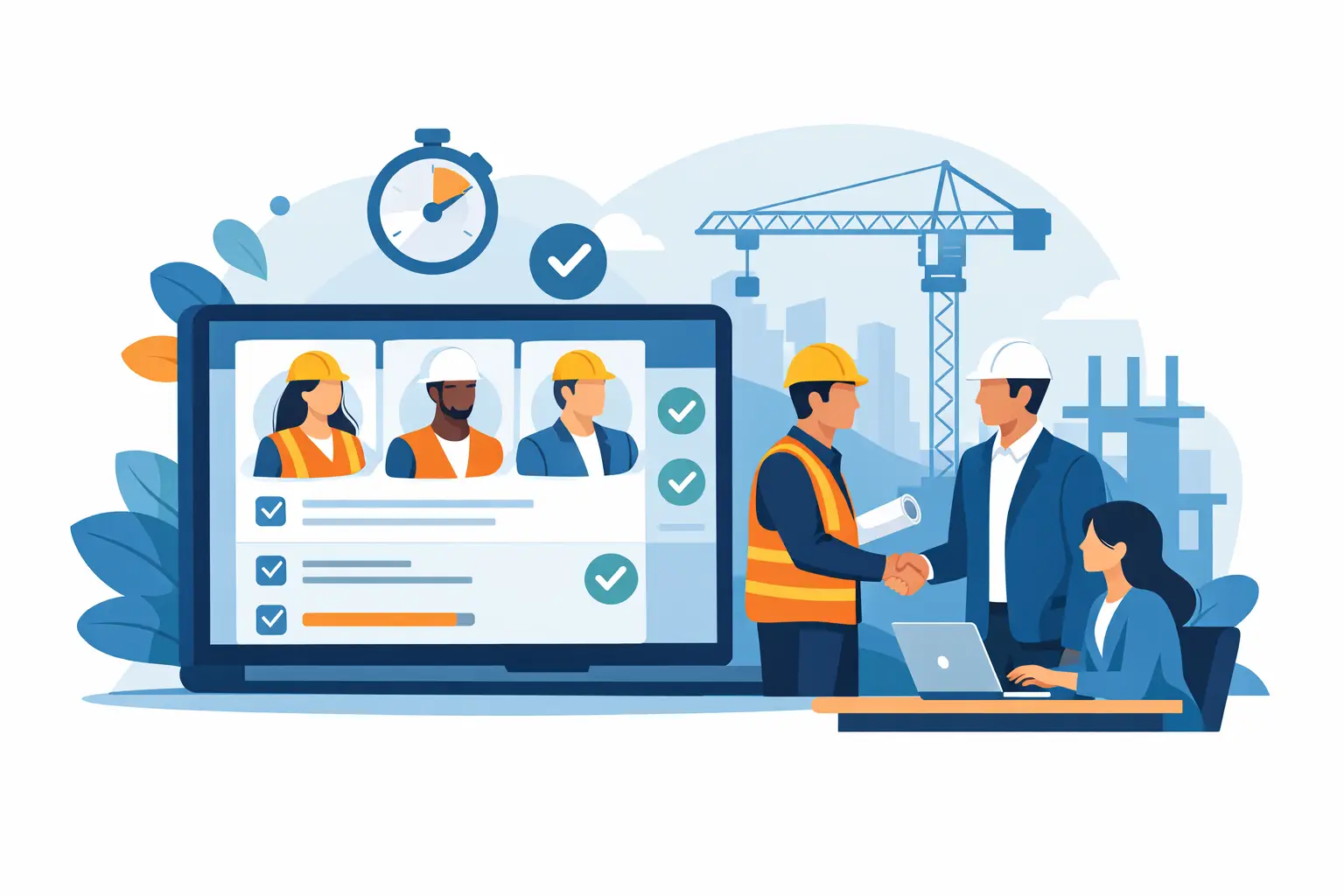
A superintendent needs three electricians by Monday. HR has a stack of applications, half without licenses, two with no relevant field experience, and one candidate who looked promising but never answered the phone. That is exactly where construction recruiting software earns its keep.
In construction, hiring is rarely neat or predictable. Crews ramp up fast, schedules shift, and one missed hire can delay a phase, push overtime costs up, or force a subcontractor to scramble. Generic applicant tracking tools were built for office roles with long timelines and polished resumes. Trade hiring works differently. You need proof of skill, clean communication, and a fast path from interest to jobsite.
The best construction recruiting software is not just a digital filing cabinet for applicants. It acts more like an operating system for hiring skilled tradespeople. It helps employers find qualified workers quickly, verify they are who they say they are, and keep hiring moving without burying the team in admin.
What construction recruiting software should actually solve
If the software only helps you post jobs, it is not solving the real problem. Contractors and trade employers are not short on places to advertise. They are short on qualified, available workers they can trust.
That is why construction recruiting software has to do more than collect names. It should narrow the field based on trade, experience, certifications, and work history. It should support project-based hiring, not just permanent roles. And it should work on mobile, because many skilled tradespeople are not sitting at desks checking email all day.
For employers, the value is speed with less guesswork. For workers, the value is visibility with proof. A good platform lets a welder, HVAC tech, or carpenter show completed projects, licenses, and employment history in a way that makes hiring decisions easier. That is very different from a generic profile with a few job titles and a one-line summary.
Why generic hiring platforms fall short
Most recruiting systems were built around white-collar assumptions. Candidates submit resumes. Recruiters screen for keywords. Interviews are scheduled over several rounds. That process breaks down fast when you are hiring for active jobsites.
Construction employers often need to answer practical questions first. Does this person hold the right license? Have they worked commercial or residential? Can they start next week? Have they actually handled the equipment, systems, or project scope this role requires?
Generic systems also tend to create friction for workers. Long forms, desktop-heavy workflows, and resume expectations can lose good candidates early. Many highly capable tradespeople have strong experience but weak paper presentation. If the platform cannot capture real-world skill clearly, employers miss talent and workers miss opportunities.
This is where industry-specific software has an edge. It reflects how hiring really happens in the trades - fast, credential-driven, and tied closely to project demand.
The core features that matter most
Not every contractor needs the same setup. A regional plumbing company hiring steady service technicians has different needs from a commercial GC staffing multiple subcontracted phases. Still, the strongest construction recruiting software usually gets a few things right.
Trade-specific matching
A broad candidate pool is not useful if it is full of mismatched applicants. Matching should account for trade, location, experience level, certifications, and type of work. Hiring a journeyman electrician for tenant improvement work is not the same as hiring a helper for a residential crew.
Better matching cuts wasted time on both sides. Employers review fewer unqualified applicants. Workers see jobs they can realistically win.
Verification and credential checks
Construction hiring runs on trust, but trust should not depend on guesswork. Software should support license validation, employment verification, background checks when needed, and clear profile details that reduce uncertainty.
This matters even more when timelines are tight. A bad hire does not just cost recruiting time. It can affect safety, productivity, rework, and team morale.
Portfolio-style candidate profiles
In the skilled trades, proof beats polish. A project portfolio gives employers context that a resume usually misses. Photos, project types, equipment used, scope of work, and employer ratings all create a stronger picture of what a worker can actually do.
For workers, this is a major advantage. It turns experience into something visible and credible, especially for people whose skills are better shown than described.
Mobile-first communication
If communication depends on email chains and desktop logins, hiring slows down. Construction recruiting software should make it easy to message, respond, and move candidates forward from a phone.
That is not a minor convenience. It is often the difference between filling a role quickly and losing a candidate to the first contractor who reached out directly.
Fast job posting and workflow control
Hiring teams need speed, but they also need order. Good software lets employers post roles quickly, filter candidates, track status, and keep communication centralized. That helps operations leaders, recruiters, and project managers stay aligned instead of managing hiring through texts, spreadsheets, and memory.
What faster hiring really looks like
Faster hiring does not mean cutting corners. It means removing delays that do not add value.
For example, if a platform already structures candidate data around trade, location, credentials, and work history, your team spends less time sorting and more time deciding. If workers can apply from a phone in minutes and respond through direct messaging, drop-off goes down. If profiles include verified details and portfolios, fewer screening calls are wasted on basic qualification checks.
That is how construction recruiting software improves time-to-hire. Not through flashy automation alone, but by reducing friction at every step.
A platform like go2work fits this model because it is designed around trade hiring instead of forcing construction employers into a generic recruiting process. Verified profiles, AI-powered matching, portfolios, and direct messaging all support the same goal: qualified hires without the usual drag.
Choosing the right construction recruiting software
The right choice depends on your hiring volume, role types, and internal process. A smaller specialty contractor may care most about speed and ease of use. A larger employer may need stronger workflow controls, team access, and more structured screening.
Still, a few questions help separate useful software from expensive clutter.
First, ask whether the platform is built for construction or merely includes construction as one category among many. That distinction matters. Industry-specific systems tend to produce better candidate quality because the data model, profile structure, and matching logic reflect trade hiring realities.
Second, look at the worker experience. If it is hard for tradespeople to onboard, update credentials, or showcase project work, adoption will suffer. The employer side can be polished, but it will not matter if the labor supply side is weak.
Third, check how the software handles trust. Verification should be more than a marketing claim. Employers need a clear way to review licenses, work history, ratings, and relevant proof points before moving fast.
Fourth, think about communication. Construction hiring often happens outside normal office hours and across active jobsites. Mobile access and direct messaging are not extras. They are core operating features.
Finally, consider whether the platform helps with both immediate openings and long-term workforce building. Some tools are fine for one-off jobs but weak for developing a repeatable talent pipeline.
For employers, the payoff is operational
When hiring improves, the benefits show up beyond HR. Project managers spend less time chasing labor. Foremen get crews staffed faster. Overtime pressure can ease. Schedule risk drops.
That is why the best construction recruiting software should be evaluated like an operational tool, not just a recruiting tool. If your teams are still relying on disconnected job boards, manual screening, and scattered communication, the cost is not only slower hiring. It is lower productivity across the business.
There is also a quality component. Better matching and stronger verification can improve retention because hires are more likely to fit the role from the start. That does not eliminate turnover, but it gives employers a cleaner shot at hiring right the first time.
For workers, better software changes access
Skilled tradespeople often get overlooked by systems that reward polished resumes over field experience. Construction recruiting software can correct that when it is designed properly.
A worker with validated credentials, a strong project portfolio, and a complete profile has a better chance of being seen for the right roles. That creates access to better jobs, stronger pay opportunities, and more control over career growth. It also gives workers a more professional way to present themselves than relying on word of mouth alone.
This matters in a labor market where good tradespeople are in demand but still spend too much time proving basic credibility. The right platform shortens that distance.
Construction hiring will probably never be simple. Schedules change, labor demand spikes, and every project creates its own staffing pressure. But the process can be a lot more controlled than it is for many employers today. The right software helps you hire with speed, proof, and less noise - which is exactly what this industry has needed for a long time.